
Key Takeaways
- Article 50 of the EU AI Act imposes transparency obligations on AI systems that interact with people or generate content — this covers most eCommerce AI, including chatbots, product recommendation engines, and AI-generated descriptions.
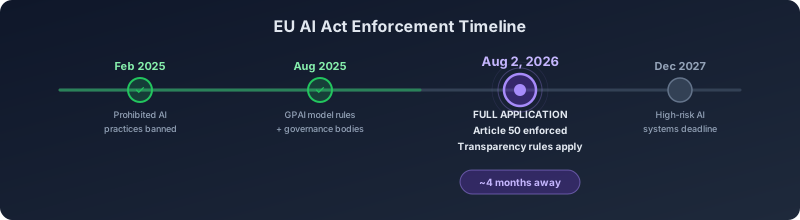
- The August 2, 2026 enforcement deadline is roughly four months away. Fines for non-compliance reach up to 7.5 million or 1% of global annual turnover.
- Most eCommerce AI falls into the limited-risk category — you are not banned or heavily regulated, but you must disclose when customers interact with AI.
- Both providers (companies building AI tools) and deployers (eCommerce businesses using those tools) have distinct obligations under Article 50.
- Compliance is achievable in weeks, not months, if you start now.
Introduction
If your eCommerce store uses an AI chatbot, personalised product recommendations, or AI-generated product descriptions, you are about to face a new legal requirement.
Article 50 of the EU AI Act mandates that businesses disclose when customers are interacting with AI systems. It applies to any organisation whose AI affects individuals in the EU — regardless of where the company is headquartered.
The full enforcement date is August 2, 2026. With roughly four months left, many eCommerce businesses are still unaware that their existing tools need transparency upgrades.
This guide explains exactly what Article 50 requires, which eCommerce AI systems are affected, what compliant disclosure looks like in practice, and how to get there before the deadline — one obligation within the wider discipline covered in our guide to what AI governance actually means. Article 50 is only one piece of what online stores owe under the AI Act — for the full picture and the 2 August 2026 deadline, see our complete guide to EU AI Act eCommerce compliance.
This article is informational content, not legal advice. For organisation-specific guidance, consult a qualified legal professional.
What Is Article 50 of the EU AI Act?
Article 50 sits within the EU AI Act's limited-risk category. While the AI Act's headline stories focus on banned AI practices and heavily regulated high-risk systems, Article 50 is the provision that affects the broadest range of everyday business AI — including the tools eCommerce companies use daily.
The core principle is straightforward: people have a right to know when they are interacting with AI rather than a human, and when content they consume has been generated or manipulated by AI.
Article 50 creates transparency obligations for two groups:
Providers (Who Build AI Tools)
If you develop AI systems intended to interact directly with people, you must design them so that users are clearly informed they are dealing with AI. You must also ensure that AI-generated synthetic content (text, images, audio, video) is marked in a machine-readable format and detectable as artificially generated.
Deployers (Who Use AI Tools in Their Business)
If you deploy AI systems — including third-party SaaS tools — that generate or manipulate content, you must disclose this to the people affected. This includes AI-generated product descriptions, marketing copy, and chatbot interactions.
For most eCommerce businesses, you are a deployer. But the obligations still apply to you directly.
Which eCommerce AI Systems Does Article 50 Cover?
Not every piece of software on your tech stack triggers Article 50. Here is how common eCommerce AI maps to the EU AI Act's risk tiers:
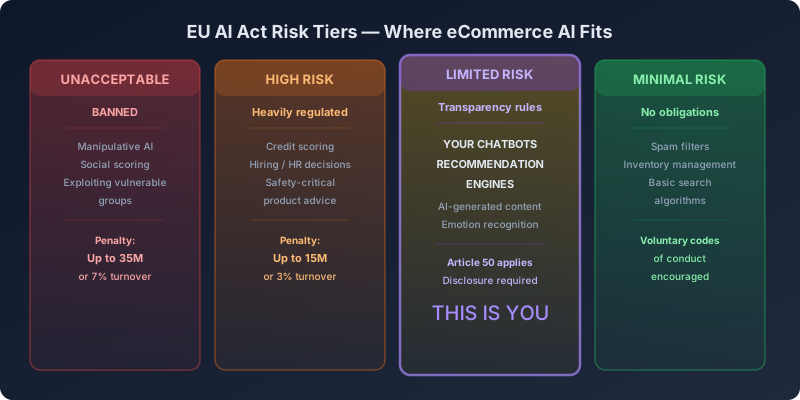
Covered: Limited-Risk AI (Article 50 Applies)
- Customer service chatbots — Any AI chatbot that interacts directly with customers must disclose it is not human. This applies whether the chatbot is custom-built or a third-party widget.
- AI-powered product recommendations — Recommendation engines that personalise what customers see. The transparency obligation applies when the system directly interacts with users in a way that could be mistaken for human curation.
- AI-generated product descriptions — If you use AI to write or rewrite product titles, descriptions, or reviews, this content must be detectable as AI-generated through machine-readable markers.
- AI shopping assistants — Conversational AI that helps customers choose products, compare options, or answer questions. And when third-party AI shopping agents check out on your store autonomously, your GDPR duties stay with you on top of these disclosure rules.
- AI-generated marketing emails — Automated copy generated by AI tools and published to inform customers.
- Dynamic pricing engines — When AI adjusts prices based on user behaviour, transparency may be required, particularly if the system could be seen as exploiting vulnerable consumers.
Not Covered: Minimal-Risk AI (No Specific Obligations)
- Spam filters
- Inventory forecasting
- Internal analytics dashboards
- Basic search algorithms
- Warehouse routing optimisation
Watch Out: Potential High-Risk Triggers
Most eCommerce AI stays in limited-risk territory. However, if your AI system crosses into safety-critical advice — such as a chatbot recommending medical devices, children's safety products, or financial products — it could be reclassified as high-risk under Annex III of the AI Act, which carries significantly heavier compliance requirements.
What Does Compliant Disclosure Actually Look Like?
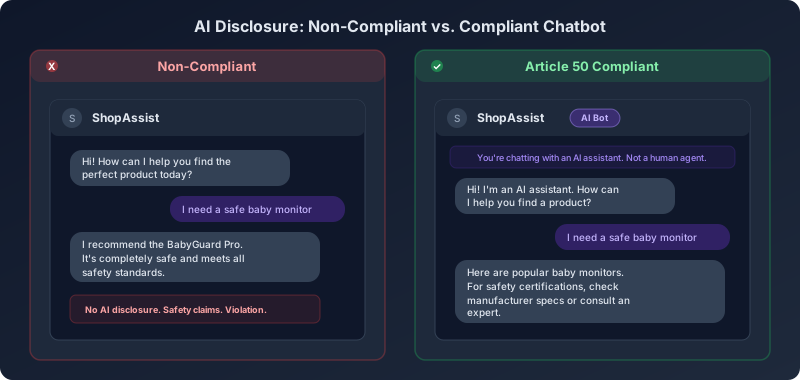
Article 50 requires transparency, but it does not prescribe a single format. The disclosure must be clear, timely, and appropriate to the context. Here is what that means in practice for eCommerce:
For Chatbots and AI Assistants
- Display a clear label at the start of the interaction: "You are chatting with an AI assistant" or "This is an automated AI response"
- Include a persistent badge or indicator (e.g., "AI Bot" tag next to the chatbot name)
- The exception: disclosure is not required if it would be obvious to a reasonably well-informed person that they are dealing with AI. A simple auto-reply saying "Your order has shipped" probably does not need an AI label. A conversational shopping assistant absolutely does.
For AI-Generated Content
- Product descriptions, marketing copy, and review summaries generated by AI must be marked in a machine-readable format — think metadata tags, watermarks, or content provenance signals (such as C2PA standards)
- If AI-generated text is published to inform the public on matters of public interest, deployers must disclose it is AI-generated. For product descriptions specifically, the machine-readable marking requirement from the provider side is the primary obligation.
For Recommendation Engines
- If personalised recommendations are presented in a way that could imply human curation (e.g., "Our experts picked these for you"), transparency is needed
- Standard "You might also like" or "Customers also bought" sections based on algorithmic recommendations generally do not require explicit disclosure, but the underlying system should be documented
Common Mistakes to Avoid
- Burying disclosure in terms of service — Article 50 requires disclosure at the point of interaction, not in a legal document nobody reads.
- Disclosing once then hiding it — If a chat session is ongoing, the AI nature should remain visible, not disappear after the first message.
- Assuming your vendor handles it — As a deployer, you are responsible for ensuring transparency, even if the AI tool is a third-party SaaS product. Check whether your vendor's default UI meets Article 50 requirements.
- Over-disclosing for minimal-risk AI — You do not need an AI label on your spam filter or inventory system. Focus on customer-facing AI interactions.
- Making safety claims through AI — If your chatbot makes assertions about product safety, certifications, or health benefits, this could push the system toward high-risk classification. Keep AI responses factual and qualified.
How Does Article 50 Interact with GDPR?
If you already comply with GDPR, you have a head start — but Article 50 adds new requirements that GDPR alone does not cover.
| Requirement | GDPR | Article 50 (AI Act) |
|---|---|---|
| Inform users about data processing | Yes (Articles 13-14) | Not specifically |
| Disclose automated decision-making | Yes (Article 22) | Yes, broader scope |
| Notify users they are interacting with AI | No | Yes — core obligation |
| Machine-readable marking of AI content | No | Yes — for synthetic content |
| Right to explanation of AI decisions | Limited (Recital 71) | Reinforced for high-risk |
| Data Protection Impact Assessment | Yes (Article 35) | Complemented by AI risk assessment |
The key addition is clear: GDPR does not require you to tell users they are talking to a chatbot. Article 50 does. For a deeper dive on how both regulations overlap, see our EU AI Act compliance guide.
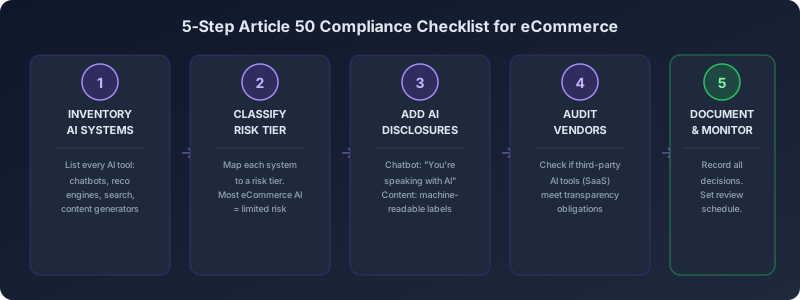
Your 5-Step Compliance Checklist
With August 2026 approaching, here is a practical path to Article 50 compliance:
Step 1: Inventory Every AI System
List every AI-powered tool in your eCommerce stack. Include:
- Customer service chatbots (Intercom, Zendesk AI, custom builds)
- Product recommendation engines (built-in platform features, third-party plugins)
- AI content generation tools (for product descriptions, marketing, emails)
- AI-powered search and personalisation
- Dynamic pricing tools
- Any SaaS product with "AI-powered" features
Do not forget embedded AI. That Shopify plugin with "AI-powered upselling" counts. That email tool with "AI subject line optimisation" counts. Cast a wide net.
Step 2: Classify Each System by Risk Tier
For each AI system, determine:
- Is it customer-facing? If yes, Article 50 likely applies.
- Does it interact directly with users? Chatbots and assistants need disclosure.
- Does it generate content users see? Product descriptions and marketing copy need machine-readable marking.
- Could it cross into high-risk territory? Check against Annex III domains (safety, health, financial advice).
Most eCommerce AI will land in limited-risk. Document your classification rationale.
Step 3: Implement Transparency Measures
For each limited-risk system:
- Add clear AI disclosure labels to chatbot interfaces
- Work with your AI content tool providers to ensure machine-readable content marking is enabled
- Review recommendation engine UIs for implied human curation
- Update customer-facing help pages to explain which interactions are AI-powered
Step 4: Audit Your AI Vendors
For every third-party AI tool:
- Request their AI Act compliance documentation
- Confirm their tools include required transparency features (disclosure UI, content marking)
- Review your contracts for AI Act compliance clauses
- Document which obligations fall on the provider vs. on you as deployer
If a vendor cannot demonstrate compliance readiness, you may need to switch providers or implement additional transparency measures yourself. Our guide on AI governance dashboards covers how to manage this vendor assessment process.
Step 5: Document Everything and Set Up Monitoring
Create a compliance record that includes:
- Your complete AI system inventory with risk classifications
- Transparency measures implemented for each system
- Vendor compliance assessments
- Decision rationale for borderline classifications
- A review schedule (quarterly is a reasonable starting point)
This documentation is what you will show a regulator if asked. Keep it current.
What Happens If You Do Not Comply?
Article 50 violations fall under the AI Act's lower penalty tier, but "lower" is relative:
- Up to 7.5 million or 1.5% of global annual turnover (whichever is higher) for failing to meet transparency obligations
- National market surveillance authorities in each EU member state handle enforcement
- Penalties apply per violation — multiple non-compliant systems mean multiple potential fines
Beyond fines, there is reputational risk. As consumer awareness of AI grows, being publicly cited for failing to disclose AI interactions erodes the trust that eCommerce businesses depend on.
For context on how enforcement is trending, see our GDPR enforcement roundup — the AI Act is following a similar trajectory of increasingly aggressive enforcement.
How PrivacyForge Helps You Stay Ahead
If you already use PrivacyForge for GDPR compliance, extending to Article 50 is straightforward. The AI Governance module is designed to handle exactly this workflow:
- AI System Registry — Catalog every AI tool across your eCommerce operation with structured metadata, purpose documentation, and deployment context. This is your Step 1, automated.
- Automated Risk Classification — PrivacyForge maps each system to the correct risk tier under both the EU AI Act and UK ICO guidelines, so you know immediately which systems need Article 50 transparency measures.
- Vendor Compliance Tracking — Assess and monitor your third-party AI vendors' compliance readiness through structured questionnaires and document management.
- Transparency Documentation — Generate the model cards, transparency labels, and compliance records that regulators expect.
- Unified GDPR + AI Act Dashboard — See your combined compliance posture in one place, with alerts when new guidance or enforcement actions affect your AI systems.
The deadline is August 2, 2026. Starting your AI inventory today puts you on track to be compliant well before enforcement begins.
Conclusion
Article 50 of the EU AI Act is not a sweeping overhaul of how you run your eCommerce business. For most online stores, it boils down to a clear obligation: tell your customers when they are interacting with AI.
The practical steps are achievable — inventory your AI tools, classify their risk, add disclosure labels, audit your vendors, and document your decisions. The deadline is fixed. The penalties are real. And the trust you build by being transparent about AI is a competitive advantage, not just a compliance checkbox.
Start with Step 1 today. List every AI system in your stack. The rest follows from there.